The biography of Szyja Blankier, Grojec
Short biography and stations of his persecution
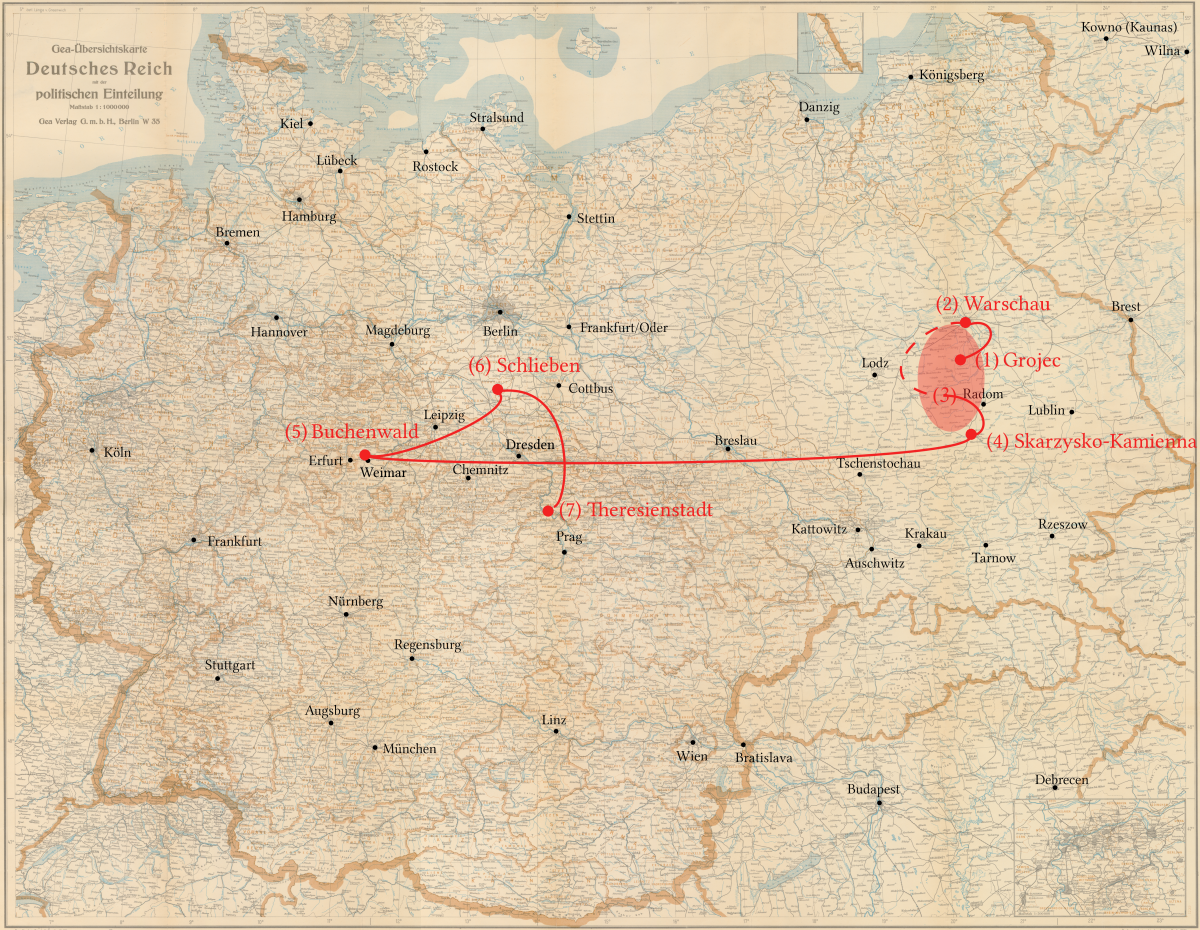
- born 15 May 1922 in Grojec
- 5 years at primary school
- Helping out in his father’s tailor’s shop
- 1939 Grojec ghetto, forced labour for SS
- Winter 1941 Warschau ghetto
- November 1942 until August 1943 illegal
- from August 1943: Skarzysko-Kamienna forced labour camp (HASAG munitions factory),
- 5 August 1944 Buchenwald concentration camp
- 14 August 1944 Buchenwald/Schlieben concentration camp (HASAG munitions factory, production of Panzerfausts)
- 7 April 1945 Theresienstadt ghetto
- 8 May 1945 Liberation
- Föhrenwald Displaced Persons Camp
- Mainkofen Displaced Persons Camp
- 1947 Emigration to Israel
Grojec/Ghetto Grojec
I am the son of Jewish parents. My father was Mordechai Blankier and my mother was Chana, née Rozenberg
I was living with my parents in Grojek when the Germans invaded in 1939. My father was a tailor and I helped him with his work. Shortly after the invasion, I was frequently taken for forced labour to an SS special unit, where I had to clean carriages and boots and carry out other tasks. I had to observe curfews and was not allowed to enter certain parts of the town.
Affidavit by Szyja Blankier, Tel Aviv, 11 September 1954

My name is Alterman Mosze, born on 24 January 1924 in Grojec, Poland, now living in ...
I knew Mr Blankier Szyja before the war. We came from the same town and were friends.
After the Germans occupied our town, the RESTRICTED ZONE was decreed in 1939. We were not allowed to enter certain parts of the town and had to observe strict curfews.
The GROJEC RESTRICTED ZONE was guarded by German patrols, and within it, a Jewish militia maintained order. The Germans established a Jewish Council headed by Bitter, to whose supervision we were subject. As a sign of our Jewish identity, we wore white armbands with a blue Star of David. I lived at Ringplatz 18 and Mr Blankier in Przenowska Street. - I worked on sewerage projects under the supervision of Polish foremen, whilst Mr Blankier was forced to perform hard labour in the SS Sonderkommando.-
Mosze Alterman (witness for Szyja Blankier), Affidavit: Tel Aviv, 22 March 1955
Ghetto Warschau/Flucht
In October 1941, I was arrested and sent to the Warsaw Ghetto. It was surrounded by walls and barbed wire and was under strict guard. Any attempt to escape was punishable by death. I was forced to wear the Star of David on an armband. I received my rations through the Jewish Council; the head of the Council was a man named Czernikow.
In October 1942, I managed to escape from the ghetto using a forged pass that I had obtained from a Polish friend. I travelled to various places and eventually arrived in Skarzysko; here I was arrested in September 1943 and sent to the Skarzysko-Kamienna forced labour camp.
Affidavit by Szyja Blankier, Tel Aviv, 11 September 1954
In October 1941, we were all transferred to the Warsaw Ghetto, which was separated from the outside world by a high wall and guarded on one side by the Jewish militia and on the other by the Polish police and the SS. We were under the supervision of a Jewish Council, chaired by Adam Czerniskow, and were still required to wear white armbands with a blue Star of David. I lived at 30 Smocza Street and he lived on Milastrasse, on the corner of Zamenhof. - We both managed to escape from the ghetto in October 1942. - We travelled to various places until we reached Bialobrzeg, where we were arrested at different times and sent off in different directions. -
Mosze Alterman (witness for Szyja Blankier), Affidavit: Tel Aviv, 22 March 1955
Whilst I was in the Warsaw Ghetto, I met Mr Szyja Blankier there in October 1941; he was born on 15 May 1922 in Groek, Poland [...] We carried out various forms of forced labour together there. We remained there together until October 1942, after which I lost track of him.
Jechiel Lidsbarski (witness for Szyja Blankier), Affidavit, date unknown
Skarzysko-Kamienna forced labour camp
This ZAL (forced labour camp) was surrounded by barbed wire and strictly guarded by the SS. Any attempt to escape was punished by death. I was given a number and forced to work in the HASAG munitions factory. The foreman was called Bosch, and the camp commander was Kellermann. I slept in a barracks with 260 men.
In August 1944, I was transferred to Buchenwald concentration camp.
Affidavit by Szyja Blankier, Tel Aviv, 11 September 1954
[…] Taken to Skarzysko to a munitions factory, where I worked in the revolver grinding shop, 12 hours a day; there I contracted typhoid fever, typhus and dysentery, accompanied by a high fever. Spent 8 days in hospital; during a selection process, a colleague from the ‘toolmaking’ department brought me back to the camp. Assigned by Obersturmführer Impfling to the Sonderkommando for light work, collecting papers and the like; returned to my previous work after 8 days. Beaten by Obersturmführer Impfling; lost 2 upper teeth.
Medical report dated 19 April 1966, Medical Board, Tel Aviv (extract)
I worked in Skarzysko at Plant C in the foundry, in the grenade department. Towards the end of 1943, I had to go every week to the delousing chamber at the Skarzysko-Kamienna forced labour camp (ZAL), where I spoke to Mr B L A N K I E R Szyja from Grojec, Poland [...] -
Elizer Weinberger (witness for Szyja Blankier), affidavit dated 12 February 1956
Buchenwald/Schlieben concentration camp

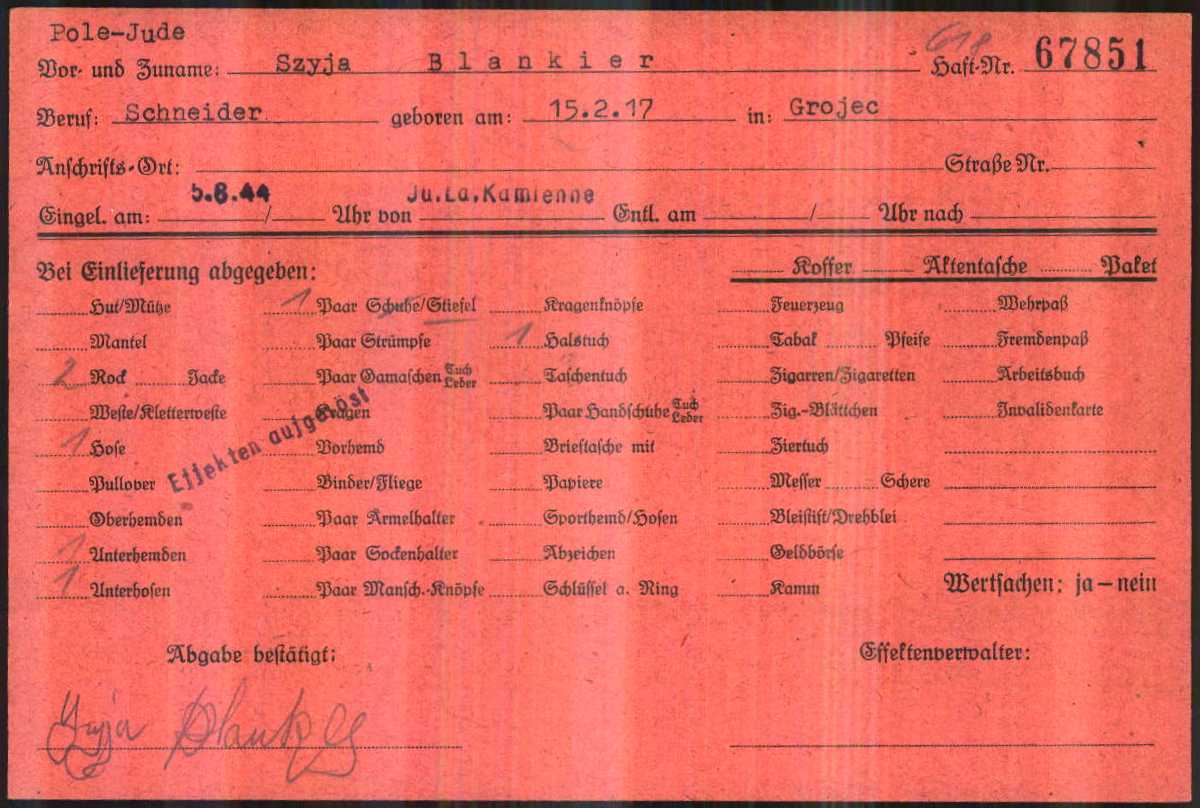
In August 1944, I was transferred to Buchenwald concentration camp. I spent two weeks in the quarantine barracks and received almost nothing to eat. I wore prison clothes with a number on them. After two weeks, I was sent to the Schlieben forced labour camp. I was forced to work in the Lehmann weapons factory, manufacturing Panzerfausts. My foreman was called Schmidt, and the director was Küken.
I slept in a room with 30 other men and, despite the hard labour, received only soup and bread as daily sustenance.
Affidavit by Szyja Blankier, Tel Aviv, 11 September 1954
At the end of 1943, transported to Buchenwald, where he carried stones, sent to the Schlieben command near Leipzig in locked trucks. There he worked in the manufacture of bazookas from trotyl, yellow powder. [...]
Expert opinion dated 19 April 1966, Medical Board, Tel Aviv (excerpt)
In autumn 1944, we arrived together in closed cattle cars at the Buchenwald concentration camp. We were given striped clothes with numbers on them. My number was 68159. We were only held there temporarily. From there, we were sent together again, after about two weeks, to [...] Schlieben. The camp was surrounded by electrified barbed wire and strictly guarded by the SS. We lived in wooden barracks and were forced to work in the Lehmann weapons factory producing Panzerfausts. We worked in alternating day and night shifts, each lasting 12 hours.
Elizer Weinberger (witness for Szyja Blankier), affidavit dated 12 February 1956
In August 1944, we were taken together to Buchenwald concentration camp and, after about two weeks, to Schlieben in September 1944. We worked together on the Panzerfaust.
Jechiel Lidsbarski (witness for Szyja Blankier)
A client of Konrad Kittl, Martin Bernhard (6 August 1919 Stopnica/Poland, 1939 forced labour in Stopnica, January 1940 Jewish star, June 1940 ZAL (forced labour camp) Biechow, February 1941- Novembert 1941 ZAL (forced labour camp) Busko-Zdroj, November 19 4 to March 19 42 ZAL (forced labour camp) Stopnica, March 1942 to October 1942 Biechow, October 1942 to August 1944 Skarzysko-Kamienna, August 1944 to May 1945 Buchenwald/Schlieben concentration camp 31/3/1946 Bettenhausen Displaced Persons Camp , 1947 Zeilsheim Displaced Persons Camp, 29/9/49 Butzbach), also reports on a bombing raid:
In the Buchenwald concentration camp and the Schlieben concentration camp, I had to work day and night shifts in the Panzerfaust factory. When the Allies bombed the munitions factory, I was buried under rubble. It was a miracle that I survived.
Towards the end of the persecution, I was nothing more than a human wreck.
Martin Bernhard (client of Konrad Kittl), undated affidavit
Theresienstadt ghetto
In April 1945, I was taken to Theresienstadt. I was housed in the Hamburger Barracks and received almost nothing to eat. On 8 May 1945, I was finally liberated by the Russians.
Affidavit by Szyja Blankier, Tel Aviv, 11 September 1954
In April 1945, we were transported together to Theresienstadt, where we were liberated by the Russians on 8 May 1945.
Jechiel Lidsbarski (witness for Szyja Blankier)
In 1945, we were transported in a closed cattle car to the Theresienstadt concentration camp. We were placed in quarantine and liberated together by Russian troops in May 1945.
Affidavit dated 12 February 1956 by Elizer Weinberger, born 31 August 1925 in Rymanow, Poland